At a leading European technology showcase this year, one theme was unmistakable: artificial intelligence has become the connective tissue across the modern smart home, influencing everything from cleaning and gardening to lighting, refrigeration, security, and whole‑home control. For homeowners and commercial operators alike, the question is no longer whether to adopt AI‑enabled devices, but how to integrate them cleanly, securely, and in ways that genuinely improve daily experience.
Below are seven standout trends from the fair, with practical integration guidance drawn from real‑world projects across houses, apartments, hotels, offices, and public spaces. The emphasis is on interoperability, network readiness, privacy and security by design, and scene‑based automations that make complex technology feel effortless.
Seven AI‑driven trends and how to integrate them
1) Multi‑storey robotic cleaning
The latest robotic vacuum systems are pairing high‑suction cleaners with stair‑negotiating carriers or lightweight shuttles that can autonomously move a robot between floors. With per‑floor mapping and improved object recognition, they promise whole‑home coverage without manual relocation.
Integration guidance:
- Designate safe transfer zones where carriers dock and pick up the robot, away from stair edges and traffic routes.
- Provide charging on each level to avoid long return paths and to ensure predictable duty cycles.
- Use per‑floor maps so each level has its own virtual boundaries and cleaning routines.
- Add fall detection near landings and top/bottom steps, supplementing onboard sensors with external edge or presence sensors if necessary.
- Schedule runs when spaces are unoccupied (office quiet times, school corridors after hours, residential daytime or late‑morning windows), and link to presence detection to pause on entry.
Design note: Where cleaning operations share space with pets or young children, integrate “do‑not‑disturb” and “gate closed” automations tied to sensors on doors or pet enclosures.
2) Permanent outdoor architectural lighting
Year‑round, individually addressable fixtures—now brighter, more colour‑accurate, and more durable—extend architectural character and safety to facades, paths, and gardens. AI‑assisted scene creation can harmonise colours with seasons, events, or occupancy patterns.
Integration guidance:
- Plan low‑voltage runs and drainage early, coordinating with landscaping to minimise trenching and prevent water ingress.
- Confirm weather ratings (IP66/IK ratings, UV‑resistant housings) and corrosion resistance appropriate to your site.
- Provide network coverage outdoors (Wi‑Fi mesh, Thread border routers, or wired data where feasible) for reliable control.
- Link lighting scenes to occupancy, schedules, and security events—e.g., illuminate approach paths on gate intercom rings or trigger perimeter brightening when cameras detect motion.
Design note: For commercial frontages, ensure scenes comply with local light‑spill and signage regulations, and add “low‑impact” night modes for wildlife and neighbours.
3) Smarter refrigeration and kitchen design
Appliances are increasingly able to recognise food types, tune humidity and airflow for freshness, and offer spill‑free auto‑dispense. Zero‑clearance doors sit flush yet open fully, enabling cleaner cabinetry lines in premium kitchens and hospitality back‑of‑house.
Integration guidance:
- Tie door‑open alerts and energy‑saving modes into whole‑home automations so lighting, screens, and HVAC respond to off‑peak or away states.
- Ensure correct ventilation and cabinetry tolerances for zero‑clearance hinges and condenser airflow, preserving efficiency and warranty compliance.
- Surface inventory or expiry reminders to user interfaces—wall touchscreens, mobile apps, or voice assistants—so shopping lists and menu planning stay current.
Design note: In mixed‑use or staff areas, pair door‑open alerts with occupancy and access control logs to deter energy waste and improve food‑safety compliance.
4) Advanced robotic lawn care
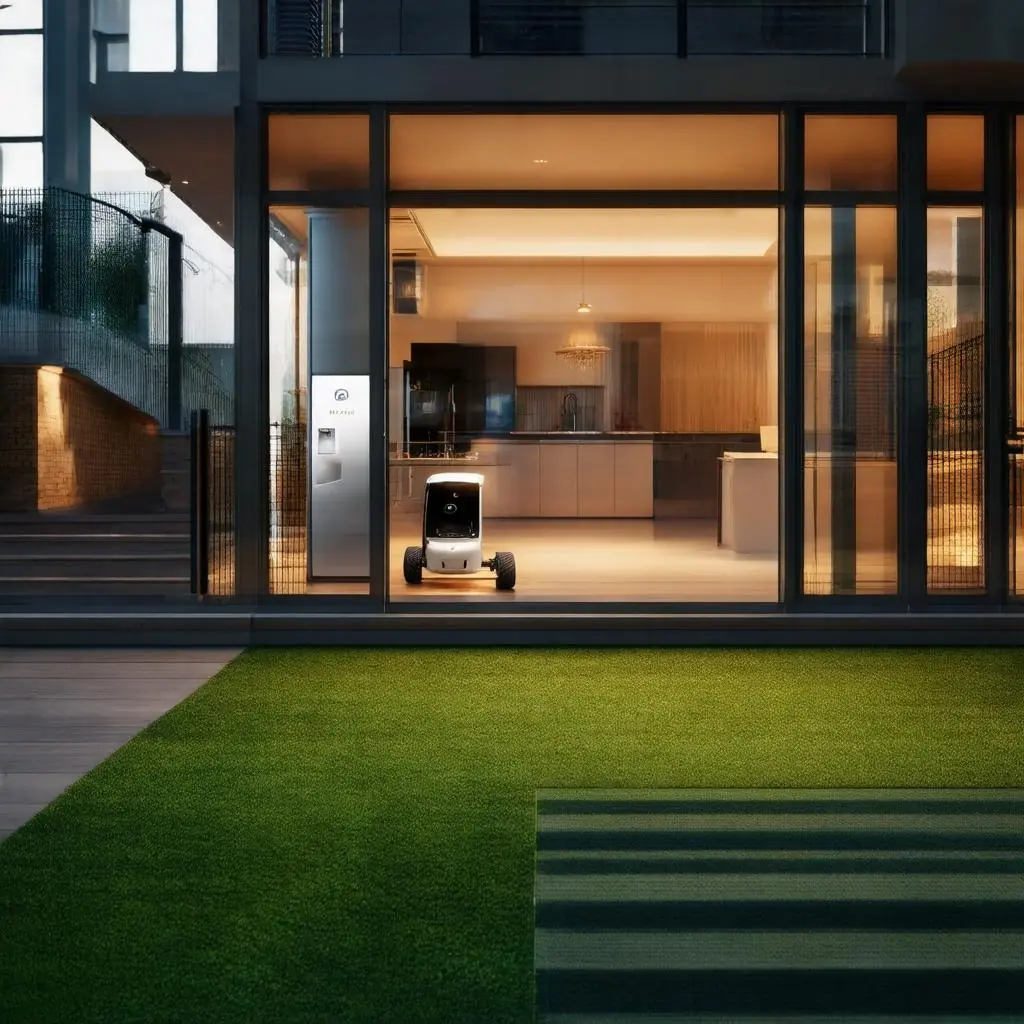
All‑terrain robotic mowers now handle steeper slopes, uneven surfaces, and complex gardens using vision‑based mapping, reducing reliance on boundary wires. AI helps identify grass from gravel, and avoid obstacles more reliably.
Integration guidance:
- Position base stations with reliable power and connectivity to support mapping updates and remote diagnostics.
- Create exclusion zones for ponds and play areas using virtual boundaries or physical edging as needed.
- Coordinate schedules with irrigation and groundskeeping to avoid wet cuts, chemical treatments, or human activity windows.
- Address camera privacy boundaries, masking neighbouring plots and public rights‑of‑way while complying with local laws.
Design note: For estates or commercial grounds, integrate mower status with facilities dashboards and automate “storm‑safe” docking based on weather feeds.
5) Next‑gen video doorbells
Higher resolution, wider fields of view, and clearer two‑way talk are now common, with some models offering a basic video history without a paid subscription. Optional face recognition is on the horizon, raising both convenience and governance considerations.
Integration guidance:
- Integrate with gates and intercoms so one press can call through to indoor stations, mobiles, or a concierge.
- Trigger lights and announcements to improve safety and accessibility, including T‑coil‑compatible audio or smart chimes for hearing‑impaired users.
- Choose local vs. cloud storage based on risk profile, retention policies, and uptime requirements—consider NVRs, encrypted SD, or hybrid models.
- Follow data‑protection best practices: clear signage, consent where required, minimised retention, access controls, and audit logs.
Design note: For UK deployments, align with UK GDPR and ICO guidance; apply privacy masking and set conservative default retention, especially in multi‑unit dwellings.
6) Quieter, compact air purification
New airflow geometries reduce noise while maintaining much of the clean‑air delivery rate associated with larger units. For homes, offices, and education, this makes continuous filtration more acceptable in occupied spaces.
Integration guidance:
- Automate by air‑quality thresholds (PM2.5, VOCs, CO2), using sensor fusion to avoid over‑reacting to short spikes.
- Link with HVAC so central fans assist distribution and dampers prevent recirculating stale zones.
- Use silent modes during calls, bedrooms, or home‑cinema use, synchronised to calendars, occupancy, or A/V system states.
Design note: In cinemas and boardrooms, coordinate purifier speeds with microphone gating to preserve audio quality.
7) Whole‑home AI ecosystems
Appliances, sensors, and services are starting to coordinate across categories—using AI to balance comfort, efficiency, and security. The direction of travel is clear: fewer isolated devices, more orchestrated experiences.
Integration guidance:
- Prioritize open standards and compatibility with your control platform (e.g., Crestron) to avoid lock‑in and maximise longevity.
- Ensure robust multi‑floor and outdoor networking—wired backbones where possible, Wi‑Fi 6/6E/7 and Thread for wireless resilience.
- Segment devices on the network with VLANs and per‑role access control to reduce blast radius.
- Document maintenance and update policies, including firmware cadence, credential rotation, and end‑of‑life plans.
Design note: For distributed audio and alerts, align ecosystems (e.g., Sonos or Nuvo) with your control layer to keep notifications, scenes, and paging consistent across rooms and terraces.
What this means for integrated projects
These capabilities, properly specified and commissioned, unlock three clear outcomes:
-
Smarter energy management: Appliances and lighting cooperate with tariffs, occupancy, and weather. Cold‑chain appliances enter eco modes during demand peaks; outdoor lighting dims or shifts spectrum after hours; purifiers ramp only when thresholds are breached. Over time, AI learns local patterns, shaving peaks and improving comfort.
-
Better security: Doorbells, gates, and perimeter lighting act as one. Video analytics can elevate critical events while filtering nuisance alerts. Robotic systems observe “quiet hours,” and cleaning or mowing halts when a protected zone is occupied. Audit‑ready logs and clear data boundaries keep governance robust.
-
Improved comfort: Scenes unify air quality, lighting, sound, and movement. “Arrival,” “Film Night,” “After‑Hours,” or “Housekeeping” modes set the ambience and the rules—silencing purifiers, dimming paths, parking robots, or pre‑warming kitchens—so spaces feel considered, not automated for their own sake.
To achieve this, focus on four pillars:
-
Interoperability: Select devices that support open standards (Matter, Thread, standard IP protocols) and integrate cleanly with your control platform. For complex estates or mixed commercial/residential sites, a professional control backbone (e.g., Crestron) remains the most predictable way to harmonise disparate subsystems.
-
Wiring and network readiness: Plan for power and data early. Outdoor low‑voltage for lighting, PoE for cameras and door stations, dedicated circuits for major appliances, and a structured cabling plan (Cat6A or better) will outlast device generations. Provide whole‑property wireless coverage, including gardens and outbuildings, with a secure, centrally managed system.
-
Privacy and security by design: Treat cameras, mics, and AI classification as sensitive by default. Minimise data collection, store locally where appropriate, encrypt in transit and at rest, segment networks, enforce MFA for admin access, and define retention and subject‑access processes compliant with UK GDPR. In commercial or public‑facing spaces, use signage and consent management consistently.
-
Scene‑based automations: Anchor complexity to understandable outcomes. Build scenes around people and operations—shift changes, booking schedules, school timetables—so the system remains intuitive and durable as devices evolve.
From concept to deployment: a practical roadmap
For homeowners, developers, facilities teams, and hospitality managers, a structured approach ensures these AI‑enabled features deliver value on day one and age gracefully.
-
Discovery and survey: Map use cases (security, entertainment, sustainability, accessibility) and constraints (heritage fabric, listed status, acoustic goals, Wi‑Fi noise). Identify outdoor coverage needs for lighting and lawn care, staircase geometry for robotic carriers, and kitchen joinery constraints for zero‑clearance appliances.
-
Design and documentation: Produce single‑line diagrams, wiring schedules, network topology (including VLANs), device lists, and control logic. Document privacy boundaries for cameras/doorbells and retention policies before hardware is ordered.
-
Infrastructure first: Install structured cabling, low‑voltage power, drainage and conduits for outdoor fixtures, and dedicated electrical capacity where required. Commission secure networking: controller redundancy, guest vs. device isolation, certificate‑based onboarding, and monitoring.
-
Pilot and commissioning: Stage devices off‑site where possible to validate firmware, integrations, and naming conventions. On site, commission per‑floor robot maps, doorbell integrations with gates and chimes, purifier thresholds, and lighting scenes tied to occupancy and schedules. Test fail‑safes: fall detection at stair landings, mower exclusion zones, and door‑open alerts.
-
Training and handover: Provide role‑based interfaces (householder, facilities, concierge), quick‑reference guides, and escalation paths. Surface key insights to dashboards: air‑quality history, energy modes, device health, and consumables (bags, filters).
-
Support and lifecycle: Define maintenance and update policies up‑front—patch windows, credential rotation, periodic privacy reviews, and end‑of‑life replacements. Log changes and keep diagrams current so future upgrades remain smooth.
As a bespoke integrator, HYDE AV brings these elements together—designing, programming, and commissioning control systems; ensuring robust, multi‑floor and outdoor networking; coordinating with architects and landscapers; and integrating trusted ecosystems such as Crestron control and Sonos or Nuvo for multi‑room audio. Whether for a London townhouse, a Suffolk coastal property, or a multi‑site commercial operator, the opportunity is to adopt AI where it makes a measurable difference, and to integrate it so it feels invisible.
The path forward is clear: specify interoperable products, invest in wiring and networks, protect privacy by design, and let scenes express the intent. Do this well, and AI will not merely add features—it will elevate how your spaces look, feel, and work every day.