In the modern enterprise, data is the lifeblood of operations, rendering the underlying physical infrastructure critical to overall business continuity. While high-specification routers, switches, and servers often dominate IT budgets, the physical routing of the copper and fibre-optic links connecting them is frequently overlooked. Implementing a rigorous system of network cable management is not merely an aesthetic choice; it is a fundamental engineering requirement that directly impacts system uptime, cooling efficiency, and hardware longevity.
The Operational Importance of Structured Cabling
When network topology is deployed without strategic planning, the result is often a chaotic mass of tangled cables—colloquially known as a ‘spaghetti closet’. This disorganization impedes airflow, causing localized heat retention within server racks. Overheated active components experience accelerated thermal degradation, resulting in premature hardware failure. By contrast, utilizing a meticulous structured cabling approach in Knightsbridge or other high-density corporate environments ensures that airflow paths remain unobstructed, allowing cooling systems to operate at peak efficiency.
Furthermore, diagnosing network anomalies in an unmanaged environment is exceptionally resource-intensive. When a single patch lead fails, a network engineer must manually trace the physical pathway through hundreds of identical, tangled wires. Professional network cable management mitigates this risk by establishing clear, logical routing paths, enabling rapid diagnostics, hardware hot-swapping, and seamless scalability as enterprise needs expand.
Best Practices for Enterprise Cable Organization
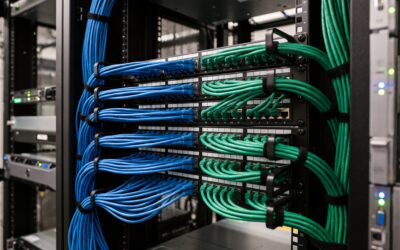
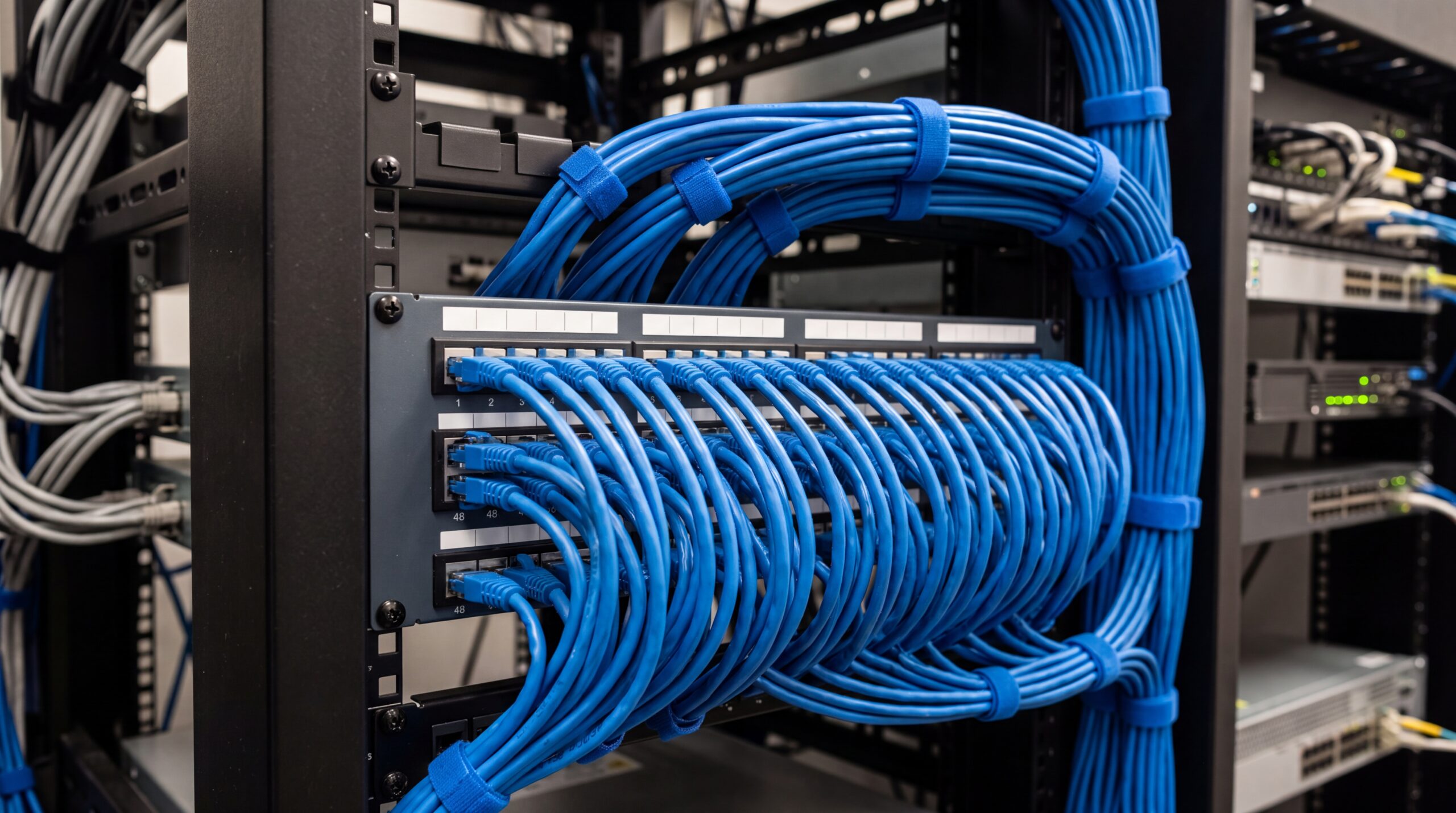
To achieve an optimal installation, several key methodologies must be standardized across any rack build or server room deployment. First, the integration of horizontal and vertical cable managers is essential. These components route patch leads cleanly away from active equipment ports to the rack sides, preserving structural order. Second, strict adherence to bend radius specifications is critical. Over-bending Cat 6A or Cat 7 Ethernet cables can induce cross-talk and signal attenuation, severely compromising data transmission speeds.
Colour-coding and systematic labelling constitute another pillar of professional network administration. Assigning specific colours to dedicated services—such as green for VoIP, blue for external WAN, and yellow for internal LAN—dramatically simplifies top-level troubleshooting. Coupled with high-durability labels at both termination points, this methodology ensures that modifications are executed with a minimal margin for error.
Localized Expertise for Professional Deployments
Achieving a high-performing infrastructure requires both technical expertise and localized knowledge of architectural demands. Historic and high-value properties require bespoke approaches to avoid structural disruption. For instance, executing structured cabling in Mayfair or designing robust structured cabling in Camden requires sensitive integration within listed buildings, balancing modern high-speed requirements with architectural conservation.
Similarly, businesses operating within dynamic commercial districts benefit significantly from localized expertise. From high-speed financial setups requiring structured cabling in Docklands to creative agencies seeking modern structured cabling in Chelsea, tailoring the physical layer to the specific architectural and operational context is critical. Whether implementing structured cabling in Kensington‘s high-end retail spaces or deploying structured cabling in Hackney‘s vibrant tech hubs, a customized approach is essential. For academic and technological centres, securing professional structured cabling in Cambridge ensures that research and commercial networks remain future-proofed against evolving bandwidth demands.
Ultimately, investing in professional network cable management pays substantial dividends over the lifecycle of your infrastructure. By partnering with experienced installation specialists, you secure a reliable, serviceable, and resilient network that can seamlessly scale alongside your organizational goals.