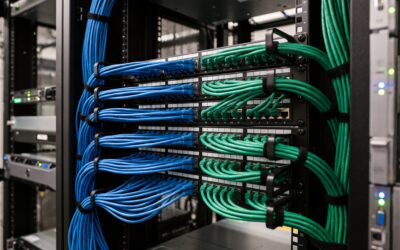
Power over Ethernet (PoE) allows a single cable to carry both data and power to networked devices. As higher-power standards mature—PoE+ (IEEE 802.3at) and PoE++ (IEEE 802.3bt Type 3 and Type 4)—a new class of switches with total power budgets around 1000 watts has emerged. In practical terms, this means one core switch can energise and connect dozens of audio‑visual and smart‑building endpoints without separate mains spurs, distributed power supplies, or wall‑wart adapters.
Key PoE variants and headline capabilities:
- 802.3af (PoE, “Type 1”): up to 15.4 W per port at the switch (≈12.95 W available at the device).
- 802.3at (PoE+, “Type 2”): up to 30 W per port at the switch (≈25.5 W at the device).
- 802.3bt (PoE++, “Type 3”): up to 60 W per port at the switch (≈51 W at the device).
- 802.3bt (PoE++, “Type 4”): up to 90 W per port at the switch (≈71–73 W at the device).
A 1000‑watt PoE budget, intelligently allocated, can power a wide array of endpoints typically found in modern AV and smart buildings:
- IP cameras (including PTZ and IR variants)
- Touch panels and room controllers
- Occupancy and environmental sensors
- Intercoms and door stations
- Access control readers
- Networked audio endpoints and paging microphones
- Small PoE amplifiers for distributed audio zones
- AV‑over‑IP encoders/decoders designed to accept PoE
- PoE lighting drivers and gateways
With this capacity consolidated into the network core, integrators can centralise power, monitoring, and control—an attractive proposition for both commercial sites and premium residences seeking clean design, security, and efficiency.
Benefits for AV and Smart‑Building Projects
- Simpler cabling and tidier infrastructure: One Category cable per endpoint replaces separate power and data runs, reducing wall clutter, containment requirements, and installation time. For retrofits, PoE frequently avoids chasing walls for new mains circuits.
- Centralised backup and resilience: When the switch stack is protected by a correctly sized UPS and surge protection, every PoE‑powered endpoint inherits ride‑through during outages and controlled shutdown/restart behaviour.
- Faster deployment and change management: Deploy devices without calling for additional electrical works. Reconfigure ports, VLANs, power priorities, and schedules via software, not screwdrivers.
- Granular energy visibility: Modern switches expose per‑port power draw via LLDP‑MED, SNMP, and vendor APIs, enabling precise energy monitoring and policy‑based power management (e.g., scheduling lights and signage, disabling idle encoders).
- Easier remote management: Reset frozen devices remotely by cycling PoE; push firmware; monitor health; and log power anomalies—particularly valuable for distributed estates and out‑of‑hours support.
- Safety and compliance advantages: IEEE PoE delivers Safety Extra‑Low Voltage (SELV) DC with negotiated power levels and built‑in protection against overloads and shorts, reducing risks associated with scattered mains adapters.
- More flexible space planning: Touch panels, readers, speakers, and sensors can be placed for optimal user experience without proximity to mains outlets.
In short, a high‑power PoE switch consolidates complexity, enhances uptime, and supports smarter energy practices—while keeping the visible environment clean and elegant.
Design Essentials and Network Features to Specify
To exploit a 1000‑watt PoE budget reliably, design and specification matter as much as raw capacity.
Power budgeting and allocation
- Per‑port classing: Map each device to its IEEE class and typical/peak draw. Use LLDP‑MED for fine‑grained negotiation where supported.
- Headroom: Do not plan for 100% utilisation. Reserve 20–30% of the total wattage for peaks, expansions, and environmental variance.
- Priority and policies: Use per‑port priority (high/critical/low) so life‑safety and security devices remain powered if the budget is saturated.
- Startup inrush: Some endpoints draw more at boot. Confirm the switch can handle simultaneous power‑up or use staged/scheduled startup.
Thermal management and rack cooling
- Switches converting 1000 W to PoE generate heat. Provide adequate rack ventilation, hot/cold aisle discipline, and clean intake air.
- Prefer field‑replaceable, front‑to‑back fan trays for dense racks. Monitor internal temperatures via SNMP and log thermal events.
Cabling quality and length limits
- Use certified Cat6 or Cat6A cabling, with Cat6A recommended for PoE++ (Type 3/4) to mitigate bundle heating and insertion loss.
- Respect channel length (up to 100 metres including patch leads). Keep bundle sizes moderate, especially in warm spaces; follow TIA guidance on PoE cabling to control temperature rise.
- Choose 23/24‑AWG solid conductors for horizontal runs; avoid marginal pass‑through jacks for high‑power ports.
Surge protection and earthing
- For outdoor cameras, gates, and exposed runs, use Ethernet surge protectors rated for PoE++ and ensure proper bonding/earthing of racks and enclosures.
- Protect the UPS and switch feed with appropriate SPDs as part of the building’s coordinated surge plan.
Standards and compliance
- Specify IEEE‑compliant switches and PDs (avoid proprietary-only PoE modes where possible).
- Verify safety certifications (LPS/SELV), country approvals (e.g., UKCA/CE), and adherence to local electrical codes.
Networking features for AV reliability
- Multicast control: Enable IGMP Snooping and a querier on the relevant VLANs; for larger topologies, use PIM at the routing layer. This is essential for AV‑over‑IP streams and discovery protocols.
- QoS: Prioritise time‑sensitive traffic (voice intercoms, control events, real‑time video). Use DSCP/CoS marking and queueing aligned with vendor guidance.
- VLAN segmentation: Separate AV, lighting, access control, guest, and management traffic for performance and security.
- Link aggregation and uplink capacity: Use LACP to aggregate uplinks; ensure backplanes and uplinks can carry peak AV bandwidth with headroom.
- Redundancy: Design for failover with switch stacking, dual modular PSUs, ring protocols (RSTP/MSTP or ERPS), and redundant core links. Where the switch is a power single point of failure, consider a secondary PoE switch for critical devices.
- Security controls: 802.1X/MAB for port authentication, DHCP Snooping, Dynamic ARP Inspection, and ACLs to protect control planes and IoT endpoints.
These foundations convert a high‑wattage promise into dependable day‑to‑day performance.
Where High‑Power PoE Fits—and Where Mains Still Wins
When PoE is ideal
- Distributed low‑to‑medium power devices: cameras, readers, room controllers, sensors, paging microphones, small amplifiers, and many AV‑over‑IP endpoints.
- Locations where adding mains is disruptive or costly: heritage properties, post‑occupancy retrofits, or high‑finish interiors.
- Systems that benefit from centralised UPS: access control, intercoms, surveillance, touch panels, and lighting gateways.
- Spaces seeking low visual impact: eliminating wall‑warts and surface conduits.
When traditional mains is preferable
- High‑draw endpoints: large displays, projectors, high‑power DSPs/amplifiers, LED walls, and larger lighting loads typically exceed PoE++ limits or are inefficient to run on PoE.
- Heat‑sensitive enclosures: if a cluster of high‑power PoE PDs would increase ambient temperature beyond limits, distributed mains supplies may be wiser.
- Regulatory/electrical requirements: emergency lighting and life‑safety systems may mandate specific circuits, isolation, or monitoring not satisfied by standard PoE alone.
Residential versus commercial considerations
- Residential: Prioritise silent or low‑noise switch models and thoughtful rack placement (utility room, plant space). Plan for aesthetic device placement, robust Wi‑Fi co‑existence, and seamless integration with control platforms (e.g., touch panels, intercoms, access control). UPS runtime often targets graceful shutdown rather than full‑hour operation.
- Commercial and public buildings: Scale and density demand rigorous VLAN design, multicast control, monitoring/alerting, and service windows for firmware. UPS autonomy is commonly longer, and facilities teams expect dashboards with per‑port power and energy data. Access control and surveillance usually take power priority.
Future‑proofing for growth
- Stackable chassis and modular PSUs: Choose switches that can stack for bandwidth and management simplicity, and accept additional or redundant PSUs to raise the PoE budget without replacing hardware.
- Scalable power policies: Implement per‑VLAN/port scheduling, power caps, and priority classes so you can add devices without re‑engineering.
- Cabling foresight: Pull extra Cat6A to key locations, home‑run to central racks, and label thoroughly. Maintain spare ducts/trunking for expansion.
- Management integrations: Prefer platforms with open APIs, SNMP/NETCONF support, and compatibility with your control ecosystem for unified monitoring and remote service.
Practical Checklist and Sample Power Maps
Deployment checklist
- Inventory endpoints: list each device, PoE class, typical/peak watts, and criticality.
- Budget with headroom: target 70–80% of the switch’s total PoE capacity under normal load; keep 20–30% in reserve.
- Select the switch: 802.3bt support, number of PoE++ ports required, stacking options, modular/dual PSUs, acoustic profile, and rack depth.
- Engineer the network: VLAN plan, QoS/DSCP policy, IGMP Snooping/querier, LACP uplinks, and redundancy.
- Cable and hardware: Cat6A for PoE++, quality terminations, patch management, and controlled bundle sizes. Use PoE‑rated patch panels and keystones.
- Power and protection: UPS sizing for switch plus PoE load, Ethernet and AC surge protection, proper earthing, and thermal design.
- Security: 802.1X/MAB, DHCP Snooping, ACLs, secure management (SSH/TLS), and role‑based access.
- Commissioning: staged power‑up, per‑port naming and documentation, firmware alignment, baseline power readings, and alert thresholds.
- Handover and support: accurate as‑built diagrams, power maps, maintenance plan, and remote monitoring access.
Sample device power maps
Example 1: Medium office floor (targeting ≈944 W of a 1000 W budget)
- 12 IP cameras with IR: 12 × 9 W = 108 W (PoE+)
- 8 room touch panels: 8 × 12 W = 96 W (PoE+)
- 30 occupancy/environment sensors: 30 × 1 W = 30 W (PoE)
- 6 intercom door stations: 6 × 15 W = 90 W (PoE+)
- 12 access control readers: 12 × 3 W = 36 W (PoE)
- 8 networked audio endpoints: 8 × 13 W = 104 W (PoE+)
- 4 small PoE amplifiers: 4 × 30 W = 120 W (PoE+/PoE++)
- 8 AV‑over‑IP encoders/decoders: 8 × 25 W = 200 W (PoE+)
- 3 PoE lighting drivers: 3 × 60 W = 180 W (PoE++)
Total estimated draw: 944 W
Notes: Maintain at least ~5% additional headroom; consider a second PoE switch or modular PSU if future lighting loads are expected to grow.
Example 2: Premium residence (targeting ≈727 W with ample expansion room)
- 8 compact IP cameras: 8 × 7 W = 56 W (PoE+)
- 6 touch panels: 6 × 12 W = 72 W (PoE+)
- 20 occupancy/environment sensors: 20 × 1 W = 20 W (PoE)
- 3 gate/door intercoms: 3 × 13 W = 39 W (PoE+)
- 4 access readers: 4 × 3 W = 12 W (PoE)
- 6 networked audio endpoints: 6 × 13 W = 78 W (PoE+)
- 2 small PoE zone amplifiers: 2 × 30 W = 60 W (PoE+/PoE++)
- 6 AV‑over‑IP endpoints: 6 × 25 W = 150 W (PoE+)
- 4 PoE lighting drivers for feature areas: 4 × 60 W = 240 W (PoE++)
Total estimated draw: 727 W
Notes: Quiet‑fan or fanless switch models are preferable for residential racks. UPS autonomy can be tuned to keep security and networking online while shedding non‑critical loads during an outage.
Closing guidance
- Validate each device’s datasheet for maximum draw and PoE class, not just typical usage.
- Mix port types wisely: reserve PoE++ ports for lighting drivers, amplifiers, and higher‑draw AV endpoints; allocate PoE/PoE+ ports to sensors and cameras.
- Document everything: per‑port labels, VLANs, PoE priorities, and wattage budgets simplify future changes and fault‑finding.
A 1000‑watt PoE switch is not merely “more power.” It is an architectural lever that simplifies infrastructure, elevates resilience, and opens the door to centralised energy and device management. With careful design and the right platform choices—stacking, modular PSUs, robust multicast/QoS, and sound cabling practices—you will deliver AV and smart‑building systems that are efficient today and ready for tomorrow’s growth.