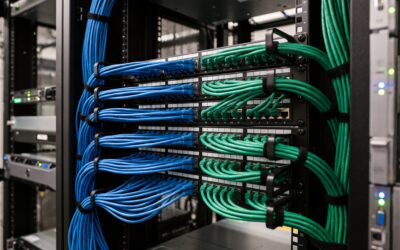
In an era defined by hyper-connectivity, cloud-first enterprise architectures, and exponential data growth, the underlying physical infrastructure of a network dictates its ultimate operational threshold. While traditional copper-based installations continue to serve essential local loops, they face physical limitations regarding distance, bandwidth, and attenuation. To architect a truly future-proof environment, modern enterprises and high-end residential developments are increasingly pivoting towards fibre-optic cabling as their foundational network backbone.
The Physics of High-Performance Data Transmission
Fibre-optic cabling operates by transmitting data as pulses of light through core threads of ultra-pure silica glass. This fundamental shift from electrical transmission to optical signalling introduces several distinct advantages. Primarily, optical fibres are entirely immune to electromagnetic interference (EMI) and radio-frequency interference (RFI). In dense commercial environments or industrial sites, where high-voltage power lines, machinery, and wireless signals can degrade copper performance, optical fibres maintain pristine signal integrity.
Furthermore, the attenuation rate of light in glass is significantly lower than that of an electrical signal in copper. This enables high-speed data transmission over kilometres rather than metres, without requiring costly inline repeaters. For organizations requiring robust, site-wide connectivity—such as corporate environments utilizing structured cabling in London—fibre-optic networks offer the bandwidth capacity required to eliminate latency and bottlenecks across the entire enterprise.
Designing the Backbone: Single-mode vs. Multi-mode Fibre
When designing a scalable network, architects must select the appropriate fibre medium based on distance requirements and bandwidth targets. The choice generally falls between two primary categories:
- Single-mode fibre (OS1/OS2): Featuring a microscopic core (typically 9 microns), single-mode fibre allows only a single pathway of light to propagate. This virtually eliminates modal dispersion, making it the definitive choice for long-haul telecommunications, campus backbones, and linking geographically dispersed buildings.
- Multi-mode fibre (OM3/OM4/OM5): Engineered with a larger core (50 to 62.5 microns), multi-mode fibre supports multiple light paths simultaneously. While subject to modal dispersion over long distances, it is highly cost-effective for localized networks, corporate data centres, and intra-building risers, such as those deployed for high-capacity structured data cabling in Essex.
Integrating Fibre in Hybrid Structured Networks
In most modern installations, fibre is not deployed in total isolation. Instead, it serves as the high-speed backbone connecting main distribution frames (MDFs) to intermediate distribution frames (IDFs). From these localized distribution points, high-specification copper (such as Cat6A or Cat7) is deployed to individual workstations, wireless access points, and smart building sensors. This hybrid topology balances the raw speed and distance of fibre with the flexibility and cost-efficiency of copper patching.
Implementing this tiered infrastructure demands meticulous planning, precision fusion splicing, and rigorous optical time-domain reflectometer (OTDR) testing. Professional integrators routinely design these complex systems to support regional hubs, delivering bespoke structured cabling installations in Suffolk and engineered data networks in Cambridgeshire.
Meeting the Demands of 2026 and Beyond
As we navigate the technological demands of 2026, network architectures must be built to withstand the next wave of digital innovation. The rapid expansion of artificial intelligence workloads, edge computing, and real-time AV-over-IP distribution places unprecedented strain on local networks. By deploying a robust fibre-optic infrastructure today, organizations secure an easy pathway for future upgrades. Network operators can scale bandwidth from 10 Gbps to 100 Gbps and beyond simply by upgrading terminal transceivers, completely avoiding the disruption and capital expense of replacing the physical cable infrastructure.