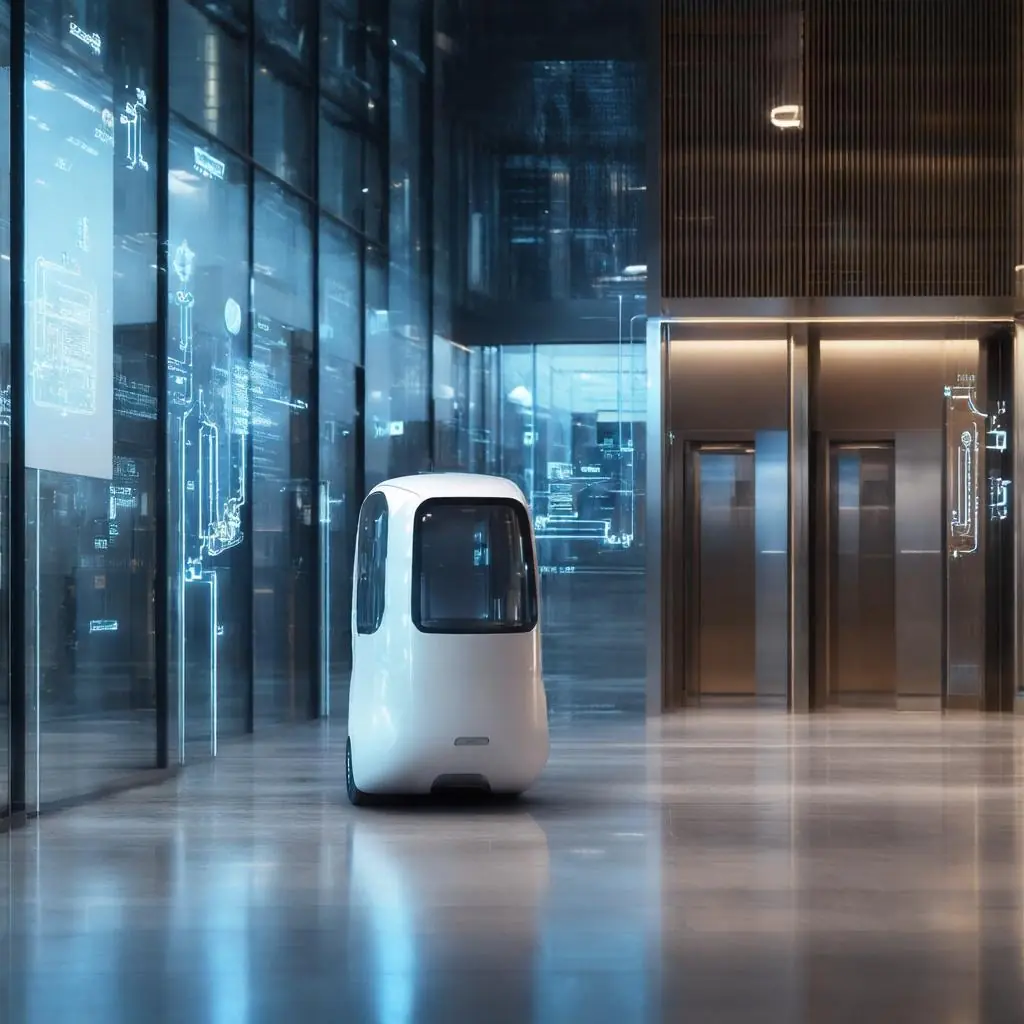
Robots are moving from novelty to everyday tools in modern audio‑visual environments, but their return on investment only materialises when they are treated as part of a fully integrated ecosystem. Standalone cleaning, delivery or media robots can demonstrate capability in isolation; integrated robots demonstrate value by responding to real‑time events and coordinating with the systems your teams already rely upon.
-
Digital signage and content: A robot can trigger context‑aware messages on surrounding displays—wayfinding that clears a path, safety notices while a unit is operating, or promotional content linked to a delivery task. Conversely, your signage CMS can instruct robots to begin a cycle after the last scheduled event in a space, or to switch to a “quiet mode” during premium screenings or board meetings.
-
Room booking and occupancy: Tying robots to room booking platforms and live occupancy feeds ensures they work when people do not. For example, a cleaning robot waits until a meeting ends and sensors confirm the room has emptied; a media robot wheels in a portable display only if a hot‑desk zone exceeds a threshold of occupants; a hospitality delivery robot schedules after‑hours routes aligned to late‑night service windows.
-
Access control and lifts: Integration with access control allows temporary, geofenced permissions so robots can pass through doors or call lifts autonomously, while rejecting routes through staff‑only areas during trading hours. Audit logs reconcile every door event to a robot task, supporting safety and compliance.
-
Payment verification: Delivery robots in hospitality and retail can verify payment and identity without friction. This may include presenting dynamic QR codes on a built‑in display for mobile payment, pairing with a contactless terminal overseen by front‑of‑house, or exchanging tokens with your POS via API to validate pre‑paid orders before handover.
-
Building management and energy: Robots can coordinate with building management systems so that HVAC is reduced in unoccupied zones being cleaned, lights are brought to a safe operating level along a route, or charging is deferred to off‑peak tariffs. In multi‑use venues, robots can be locked out during events that require absolute quiet or darkness.
Technically, this kind of responsiveness is achieved through open integration points. Event‑driven orchestration—combining APIs and message buses (e.g., REST, WebSocket, MQTT) with your control processors and scheduling platforms—lets robots subscribe to what the building is doing and publish what they are about to do next. In many deployments, a central control system (for example, a Crestron processor) acts as the translator among digital signage, room booking, access control, POS and BMS endpoints, maintaining a single source of truth about time, place and permission. The result is not “a robot that cleans” but “a space that cleans itself when people leave, tells guests what is happening, and resumes normal operation automatically”—a meaningful shift in user experience and operational efficiency.
Service and reliability: run robots like critical IT
In customer‑facing environments, robot downtime must be treated like IT/server downtime. A robust service model is therefore non‑negotiable:
-
Rapid SLAs: Define response and resolution times that mirror your core AV and IT systems. For hospitality or retail, that typically means same‑day response for critical faults and next‑business‑day fixes at the outside.
-
Hot‑swap spares: Maintain an on‑site or near‑site hot‑swap pool so a faulty unit can be replaced in minutes, not days. Spares should include batteries, brushes/consumables, mission‑critical sensors and a fully configured backup robot.
-
Remote diagnostics: Always‑on telemetry supports proactive maintenance. Health data (battery cycles, motor currents, sensor status) triggers alerts before failures occur, and secure remote access allows engineers to triage without a site visit.
-
Over‑the‑air updates: Firmware, navigation maps, safety rules and workflows should be delivered via signed OTA updates on a controlled cadence with rollback capability. Treat releases with the same change control you apply to your control systems.
-
Warranties and lifecycle planning: Map warranty coverage to anticipated duty cycles and include options for extended cover. Plan for battery replacement windows, consumable stockholding and end‑of‑life recycling.
-
Structured user training: Provide role‑specific training and refresher modules—front‑of‑house, facilities, security and IT—covering safe starts/stops, basic recovery, content/workflow changes, incident reporting and data handling.
-
Operational governance: Establish service runbooks, performance dashboards, incident SLAs and a regular review cadence. Integrate robotics events into your NOC/SOC tooling so alerts appear alongside AV and network issues.
When robots are woven into your AV and building operations in this way, reliability becomes predictable, not aspirational. That discipline is what turns a successful pilot into a scalable fleet.
Human‑centred design, safety and privacy by design
Effective service robots are approachable and collaborative; they need not mimic humans. Design choices should favour clear intent, courtesy and predictability:
-
Collaborative behaviour: Use lighting cues, subtle audio prompts and on‑screen messaging to signal direction changes, waiting states and requests for assistance (e.g., “Please tap your card to collect your order”). Avoid uncanny humanoid mimicry that can unsettle guests.
-
Safe motion: Depth cameras, ultrasonic sensing and 360‑degree perception allow confident navigation at safe speeds. Hard geofencing and soft virtual zones keep robots out of restricted areas and away from drop‑offs or stairs. Emergency stops must be physical and obvious.
-
Privacy and data minimisation: Default to not recording where possible; if video is required for navigation, process at the edge and discard frames immediately. Anonymise telemetry, encrypt data in transit and at rest, and retain only what is necessary for operations and audit.
-
Auditability and access: Maintain immutable logs of tasks, locations and access events linked to user roles. Apply role‑based access control across dashboards and mobile apps, with SSO and MFA where supported.
-
Risk management aligned to standards: Conduct ISO‑aligned risk assessments (e.g., ISO 12100 for risk assessment methodology; ISO 13482 for personal care/service robots; ISO 3691‑4 for driverless industrial trucks where relevant) and complement with information security controls aligned to ISO/IEC 27001 for backend systems. Pre‑deployment testing should include collision‑avoidance validation, fail‑safe behaviour under sensor loss, and evacuation/egress simulations.
This combination of human‑centred interaction, layered safety and privacy by design preserves trust while enabling robots to work alongside staff and guests naturally.
Sustainability with real‑world outcomes across sectors and homes
Sustainability has moved from “nice to have” to a decisive buying driver in tenders across hospitality, retail, corporate and education. Robotics can contribute measurable gains:
-
Reduced water and energy: Precision dosing and route optimisation cut water and chemical use in cleaning. Coordinated charging during off‑peak periods and workload scheduling to cooler hours reduce energy intensity.
-
Lower emissions: Electric service robots displace fossil‑fuelled machinery and reduce the need for inter‑site travel when combined with remote monitoring, contributing to lower Scope 1 and 2 emissions, with knock‑on benefits for Scope 3.
-
ESG reporting: Robots generate auditable metrics—litres of water used per square metre, kWh per task, CO2e avoided, hygiene pass rates—that feed directly into ESG and sustainability reporting, strengthening bids and demonstrating continuous improvement.
Real‑world scenarios demonstrate how these benefits appear on the floor:
-
Automated cleaning for hygiene compliance: In corporate and education settings, robots can perform nightly sanitisation aligned to schedules, documenting coverage for audit. In hospitality, public‑facing areas can be spot‑cleaned between service windows based on live footfall.
-
After‑hours guest deliveries: Hotels and residential developments can move to late‑night deliveries—amenities, room‑service, documents—without disturbing guests, relieving staff during thinly resourced shifts and improving response times.
-
Robots embedded in media workflows: In venues and studios, robots can reposition portable displays, move media carts, or act as mobile camera bases and telepresence units, coordinated with production cues and signage to streamline rehearsals and events.
Homes benefit from the same principles when tied into a broader smart ecosystem:
-
Presence detection and quiet hours: Link vacuum, mopping and lawn robots to occupancy sensors and geofencing so they work only when residents are out, and enforce quiet hours automatically for neighbours’ comfort.
-
Security modes: Suspend or dock robots when the home is in “armed” mode; allow controlled operation via intercom when a trusted delivery occurs.
-
Energy optimisation: Schedule high‑draw tasks against dynamic tariffs and solar generation, and report energy/water use in the same dashboards that manage lighting, HVAC and audio.
In all cases, the differentiator is not the robot itself, but the integrated behaviours and measurable outcomes the robot enables within an AV‑led environment.
A practical checklist for your first deployment
Use this checklist to structure a low‑risk, high‑impact introduction to robotics in your AV estate.
-
Integration points
- APIs and eventing: Confirm REST/WebSocket/MQTT endpoints for robots and your AV/BMS platforms; define the event schema for occupancy, schedules, access and payments.
- Control systems: Map orchestration to your control layer (e.g., Crestron) and ensure bidirectional status between robots, digital signage, room booking and access control.
- Building systems: Verify compatibility with BMS protocols (e.g., BACnet/Modbus via gateways), lift controllers and door hardware.
- Content and UX: Prepare signage templates and audio cues that will be triggered automatically during robot operations.
- Security: Implement network segmentation, certificate management and least‑privilege access for all robot services and dashboards.
-
Pilot design
- Scope: Choose contained, high‑visibility use cases (one floor, one front‑of‑house area) with clear “start/stop” states linked to schedules and occupancy.
- Stakeholders: Involve facilities, front‑of‑house, IT/security, procurement and H&S from day one; appoint a business owner for outcomes.
- Safety and privacy: Complete ISO‑aligned risk assessments, DPIAs where applicable, and on‑site safety drills; define geofences and emergency procedures.
- Training and comms: Provide concise user training and guest‑facing communications so the pilot feels intentional and reassuring.
- Change control: Establish an OTA update plan, maintenance windows and rollback procedure before go‑live.
-
Success metrics
- Uptime and task completion rate
- Staff hours saved or reallocated
- Cleaning coverage and hygiene audit pass rates
- Guest/staff complaints reduced (noise, cleanliness, delivery delays)
- Water, energy and chemical use per task; CO2e avoided
- Safety incidents and near‑misses (target: zero, with transparent reporting)
-
Managed service and revenue opportunities
- Robotics‑as‑a‑Service (RaaS): Bundle hardware, software, updates and support into predictable OPEX.
- Monitoring and SLAs: Offer proactive monitoring with tiered SLAs, hot‑swap spares and consumables management.
- Workflow and content updates: Provide periodic optimisation of routes, signage and integrations as the estate evolves.
- ESG and compliance reporting: Deliver quarterly sustainability and compliance packs extracted from robot telemetry.
- Fleet expansion planning: Use pilot data to justify scale‑up across sites, with standardised playbooks and integration templates.
Treating service robots as first‑class citizens in your AV ecosystem—integrated, governed and measured—turns a promising technology into a dependable differentiator. By aligning robotics with digital signage, scheduling, access, payments and building systems, and by operating them with IT‑grade discipline, organisations can improve guest experience, staff efficiency and sustainability outcomes in equal measure.